As an Amazon Associate, we earn from qualifying purchases. Some links on this site are affiliate links at no extra cost to you. Our recommendations are based on thorough research and editorial judgment.

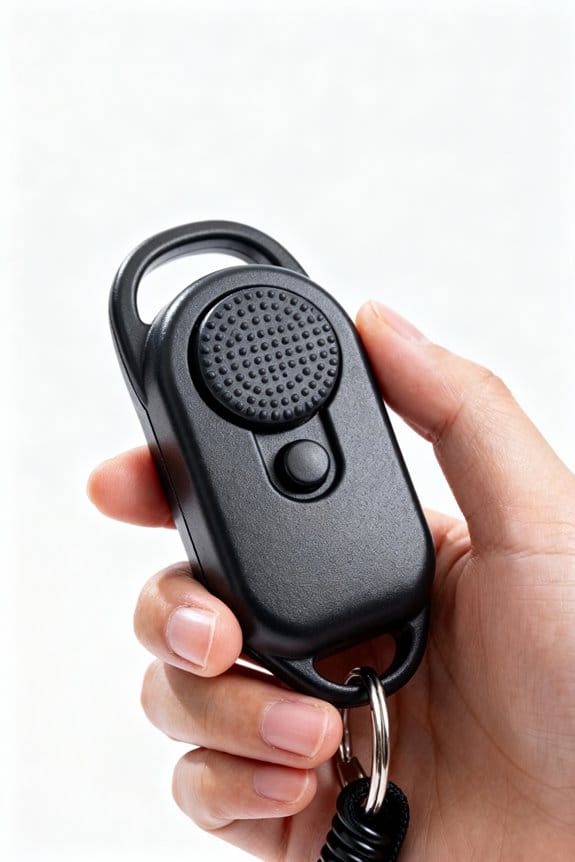
What Is a Training Clicker and How Does It Work

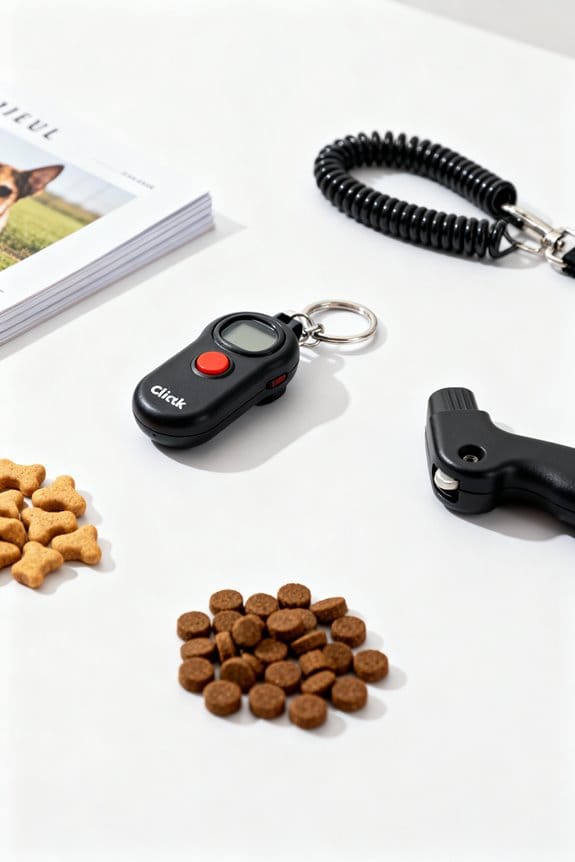
A training clicker is a small handheld device that produces a sharp, consistent sound, used to mark behavior precisely. It works by operant conditioning, the click is paired immediately with a reward, creating a clear cue for animals. Timing matters: a click within 0.5 seconds signals the exact moment to reinforce, after 10–20 pairings association forms reliably. Train short 10–15 minute sessions, repeat daily, use higher-value treats when distracted, expect faster learning. More guidance follows.
Key Takeaways
- A training clicker is a small device that makes a consistent, distinct sound to mark desired animal behavior precisely.
- It works by pairing the click with an immediate reward so animals learn to associate the sound with reinforcement.
- Effective training requires clicking within about 0.5 seconds of the desired action to create a clear behavior-reward connection.
- Charge the clicker by repeating click-and-treat sequences 10–20 times in a quiet setting to build the association.
- Clicker training speeds learning, improves retention, and lets you shape complex behaviors through successive approximations and consistent reinforcement.
The Science Behind Clicker Training
You may be interested
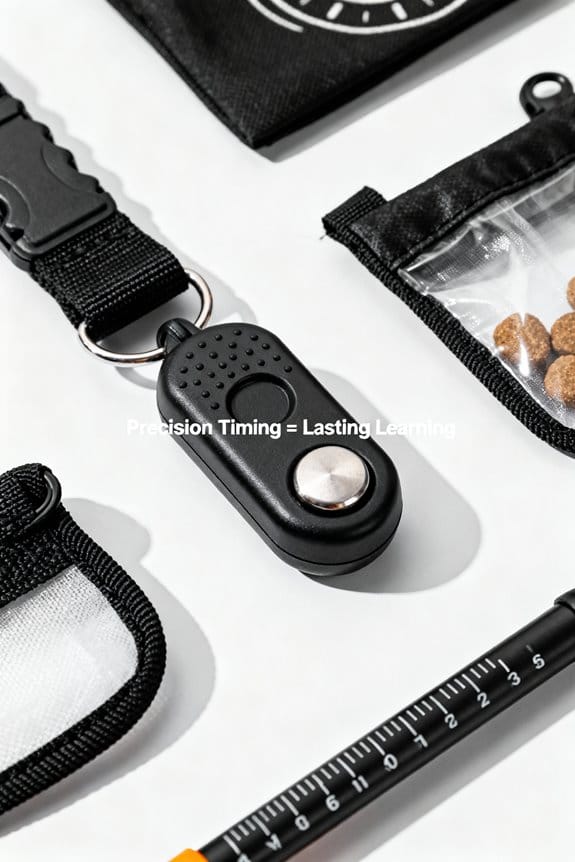
Understand how clicker training applies operant conditioning, where a distinct click sound immediately associates a specific behavior with a reward, creating a clear learning signal. Clicker training is a training method that pairs a bridging stimulus, the click, with a reward, typically food or praise, to mark a desired behavior within 0.5 seconds. How fast must the click occur to be effective? Within one second, ideally 0.5 seconds, because timing causes precise association and higher learning efficiency. Trainers use positive reinforcement to increase repetition of actions, for example teaching three steps, sit, turn, target, in short sessions of five minutes. The clear feedback of click and reward reduces confusion, improves retention by 50% in some studies, and supports consistent animal training across handlers daily. Volume-adjustable clickers can help accommodate sensitivities in noise-sensitive pets, ensuring a comfortable and effective training experience.
Getting Started: Charging the Clicker
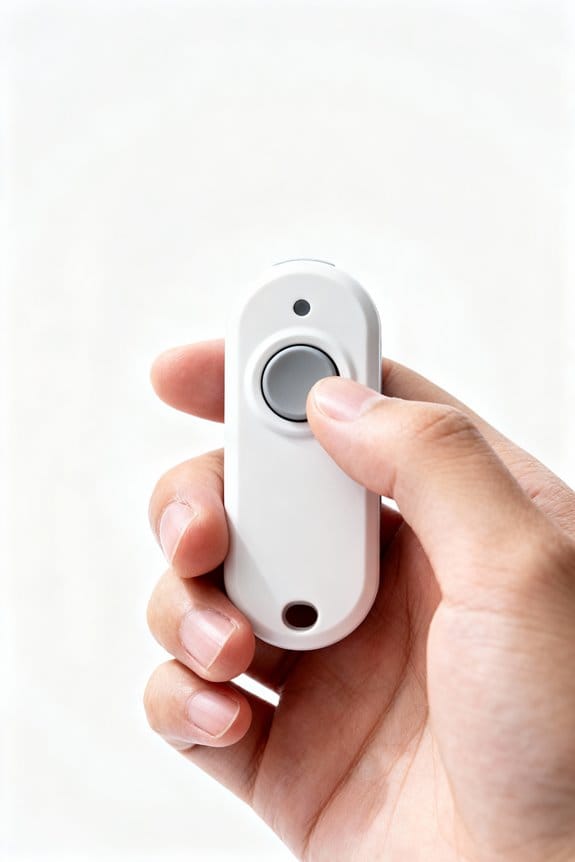
When beginning clicker training, the trainer should charge the clicker in a quiet, distraction-free area, pairing each click with an immediate reward. Charging the clicker means creating an association between the click sound and a positive experience, so the animal learns that a reward follows. The trainer clicks, offers a small treat, and repeats this sequence ten to twenty times in a distraction-free environment, until the link is clear. How many repetitions are needed depends on the animal, but consistent timing produces reliable outcomes. Proper charging supports later marking desired behaviors, because the click sound already predicts a reward. Short, focused training sessions of a few minutes, interspersed with breaks, help maintain attention and strengthen the association for future work and improve learning speed. It’s important to avoid inconsistency in timing the clicker with commands during training to ensure the most effective learning experience.
Step-By-Step Training Process

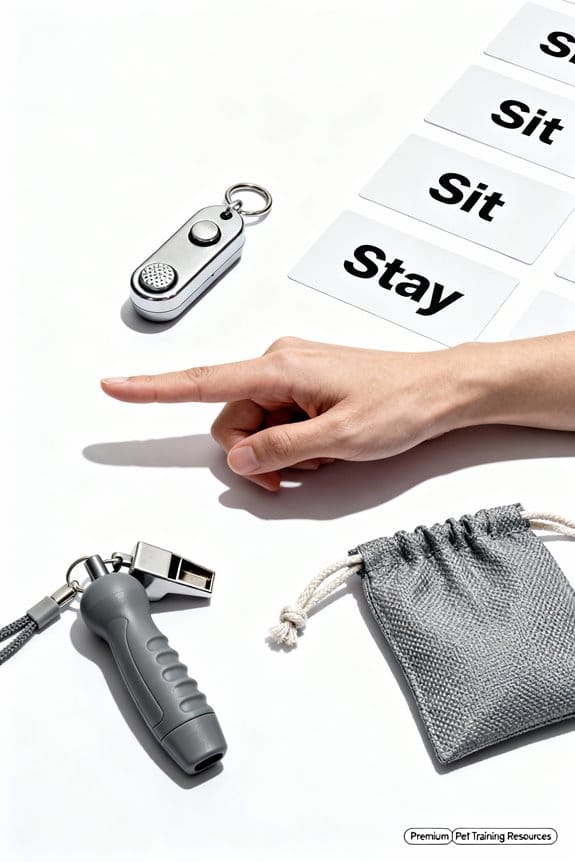
After charging the clicker in a quiet area, the trainer begins by targeting one simple behavior, like sit or touch hand. Using clicker training, the practitioner first charges the device, then clicks at the exact moment the desired behavior occurs, providing immediate feedback and clarity. Each click is followed by a reward, typically food treats, brief praise, or a quick pat, so the associated behavior becomes reinforced. Once the animal reliably offers the action in short sessions of ten to fifteen minutes, a verbal cue can be introduced, linking cue to action. How can complexity grow? By shaping successive approximations, increasing difficulty gradually, maintaining positive reinforcement, and ensuring training that uses consistency and timing. This method helps teach your dog reliably, with predictable, clear outcomes. Consider using ergonomic grips to minimize hand fatigue during longer training sessions.
Recommended Products

FULLY MODULAR HANDLE DESIGN WITH ADJUSTABLE ERGONOMICS – Includes interchangeable 3- and 4-finger extensions, two thumb barrel sizes, and two barrel post lengths so archers can customize fit, reach, and grip feel to achieve optimal hand alignment and release control in any shooting environment

Your Smart Entertainment & Fitness Tracker - Connect via Bluetooth to control short video platforms, e-books, and interactive games hands-free. The app doesn’t just count reps; it tracks your workout data, helping you monitor progress and stay motivated. Turn screen time into active, stress-relieving exercise (Note: It Does Not Provide Grip Strength Measurement, Nor Does It Offer Adjustable Resistance)

Real-Time 0–440 lb Grip Readout — As a grip strength trainer, it shows accurate lb instantly; in Vibration mode, intensity scales with your squeeze for targeted feedback and recovery. No sound.
Troubleshooting Common Problems
Common problems in clicker training appear as lack of response, inconsistent behaviors, or accidental clicks, and require systematic troubleshooting steps and adjustments. If the pet does not respond, the trainer should repeatedly click and immediately deliver a food treat, rebuilding a positive association so the behavior is learned. If accidental clicks occur, follow through with a reward to prevent confusion, and then pause to reset timing before resuming practice. When behavior is inconsistent, evaluate their motivation, use clear and consistent cues, and reinforce small successive steps toward the target action. Training uses a calm, focused environment to reduce distractions, and higher-value rewards may re-engage a distracted animal. Clear markers facilitate communication between the owner and the dog, accelerating the learning process, providing immediate feedback, and building a reliable foundation for long-term obedience. How can timing improve outcomes? Precise timing marks the moment when your dog performed the intended action.
Tips for Teaching Advanced Behaviors and Tricks
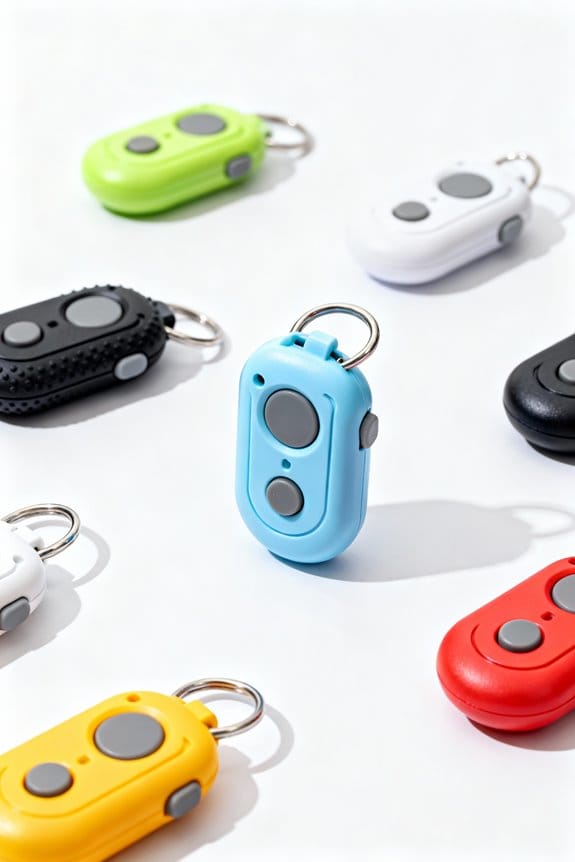
If a trainer aims to teach complex tricks, the behavior should be decomposed into small, manageable steps, each clearly marked with the clicker. A dog trainer begins with simple commands, ensuring a solid foundation before teaching your dog advanced behaviors and chained cues across settings. Shaping techniques in clicker training are applied by rewarding approximations, for example clicking for a brief sit, then longer stays, then down. How does one keep momentum, by using play, rewards, breaks, and adjusting rewards to engage your pet during training? Training sessions should be short sessions of about 10-15 minutes, repeated daily for steady progress. Positive reinforcement, precise clicker timing, and consistent criteria help a dog trainer improve retention and generalize advanced behaviors during real-life situations and patience. When choosing clickers for training, consider durable materials like rust-resistant metal or high-quality plastic to ensure longevity and reliability.
Frequently Asked Questions
How Does Clicker Training Work?
It uses clicker sounds to mark behavioral cues, pairing them with reward systems and positive reinforcement; timing importance and consistency benefits training sessions enable gradual progression with dog focus, though clicker alternatives can serve similarly.
What Are the Negatives of Clicker Training?
Critics note behavior-modification, common-misconceptions, owner-commitment, training-frustrations, timing-importance, learning-pace, clicker-alternatives, training-limitations, over-reliance-issues, negative-reinforcement, dog-temperament, individual-variations, environmental-distractions, training-consistency, equipment-costs, accessibility-barriers, socialization-challenges, training-duration, mixed-signals, user-experience that highlight practical limits for many owners during real-world sessions and reduced engagement.
Do Clickers Really Work for Dog Training?
Yes. Multiple studies show Clicker benefits: positive reinforcement improves training effectiveness and behavior modification through sound association, boosting learning speed, training consistency; it serves as a communication tool for skill acquisition and increases dog engagement.
What Is the Hardest Command to Teach a Dog?
Like climbing a mountain, the hardest command to teach a dog is ‘stay’. Hardest commands, advanced obedience, patience requirements, dog intelligence, training difficulties, consistency challenges, specialized skills, complex behaviors, breed differences and trainer experience factor.
Conclusion
Clicker training reliably marks precise behaviors, producing faster learning in many dogs than using voice cues alone, consistently observed. Is it merely a gimmick, or does empirical evidence show measurable improvement with 5–10 clicks per short session, daily? For example, after 5–10 clear clicks per trial, a dog can learn a sit cue within 2–14 days, consistently. Trainers should vary rewards, record 3–5 short sessions daily, and troubleshoot timing delays to sustain reliable results, consistently.