As an Amazon Associate, we earn from qualifying purchases. Some links on this site are affiliate links at no extra cost to you. Our recommendations are based on thorough research and editorial judgment.


How to Choose Leash Length for Training

Choose leash length based on training goals, environment, and dog size, 3–4 foot for tight control during obedience work. A 6-foot leash suits everyday walking and loose-leash training, offering moderate freedom and quick cue delivery. Long lines, 15–50 feet, enable graduated off‑leash recall practice, start 15–20 feet for beginners, progress to 30–50 feet for advanced skills. Consider material and width for strength and handling and safety, practice two-hand technique to improve control, further guidance follows.
Key Takeaways
- Match leash length to training goal: short (3–4 ft) for close-control, 6 ft for everyday obedience, long line (15–50 ft) for recall practice.
- Choose based on dog’s skill and distractions: beginners use shorter lines; advanced dogs can handle longer lines for freedom and reinforcement.
- Consider environment and safety: urban or traffic areas need shorter leashes; open fields allow longer lines for controlled exploration.
- Pick durable material and appropriate width: biothane or nylon, 5/8″ for small/medium, 3/4″ for larger breeds.
- Use proper handling: two-hand technique, waist belts, and timely pressure-release cues to communicate and prevent tangles.
Why Leash Length Matters for Training
You may be interested



Because leash length directly alters a dog’s movement and sensory engagement, trainers must choose lengths that match training goals. Leash length determines how much exploration is possible, longer lines allow sniffing without pulling while still permitting control from a distance. What scenarios require a long line of 15 to 50 feet for recall training, and when does six feet balance freedom with handler authority? Trainers select lengths based on specific training goals, distractions present, and the dog’s learning stage, using concrete distances to shape behavior. This approach enables effective communication through consistent pressure and release, it also reduces confusion during complex cues. Examples include off-leash feel with retained control, mid-range freedom for socialization, and close handling for precision skills. Select deliberately, assess results regularly. Regular grooming can help reduce allergy symptoms by removing potential allergens from your dog’s coat, which can be beneficial when spending time outdoors during training sessions.
Short Leashes: When and How to Use Them

When managing close-contact training or maneuvering crowded streets, a handler should choose a short leash of three to four feet for greater control. Short leashes provide precise control during obedience sessions, keeping dogs within arm’s reach, reducing reaction time, and limiting sudden lunges when faced with distractions. How does proximity improve communication and learning? It allows immediate cue delivery, clearer body language, and consistent reinforcement, which reduces leash aggression and strengthens walking habits. In urban settings a four-foot length prevents entanglement, minimizes risk near traffic, and supports handler authority. For strong pullers, pairing a short leash with timed corrections and reward-based training encourages loose-leash walking, while regular practice in varied environments generalizes calm responses. Start sessions briefly, then increase duration as reliability improves steadily. Long line leashes offer versatility for more extensive training scenarios, providing opportunities for recall training and obedience work in open fields.
The Classic 6-Foot Leash for Everyday Work

Although often overlooked, the classic six-foot leash provides a reliable balance of control and freedom, suitable for most everyday walks and training sessions. The 6-foot leash is the standard leash length for dog training, allowing handlers to keep dogs close for safety, while permitting exploration without excessive tension. Reflective stitching on some leashes adds visibility and safety during nighttime walks. How does this length aid loose-leash walking? It shortens response time, reduces pulling behavior, and improves communication during corrections and rewards. Choose widths from 1/4″ to 3/4″ to match size and strength, and consider leather for durability or rope for a lighter feel. Dog owners benefit from predictable handling at parks, sidewalks, and training rings, because consistent leash length simplifies cues, enforces boundaries, and promotes both safety and reliable progress, and fosters calmer, more focused dogs.
Long Lines and Off‑Leash Recall Training
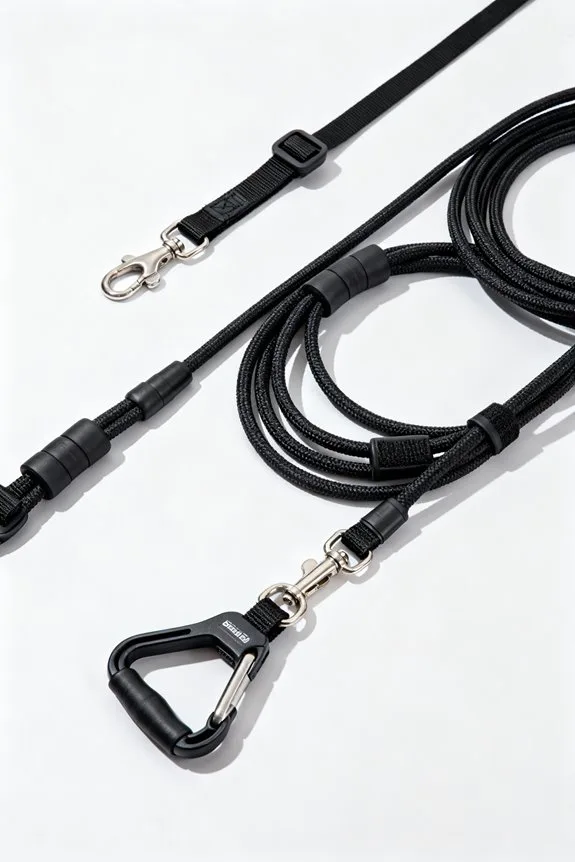
Freedom on a long line means controlled independence, allowing dogs to explore up to fifty feet while handlers retain authority. Long lines typically range from fifteen to fifty feet, providing dog freedom, and they are essential for off-leash recall training that reinforces commands. How should handlers choose length for specific goals? Shorter lines, fifteen to twenty feet, suit beginner training, enabling tighter control and quicker corrections, while longer lines, thirty to fifty feet, support advanced recall work in open spaces. Using longer lines can reduce leash pulling by letting dogs reposition and investigate, decreasing tension and improving responses during training sessions. Trainers should manage tangles and busy environments, ensuring safety and clear signals, because practice and careful handling determine successful shift to off-leash control. It is important to incorporate clickers into training routines for precise behavior marking, as they support effective communication and faster learning during sessions.
Material, Width, and Handling Tips for Safer Walks
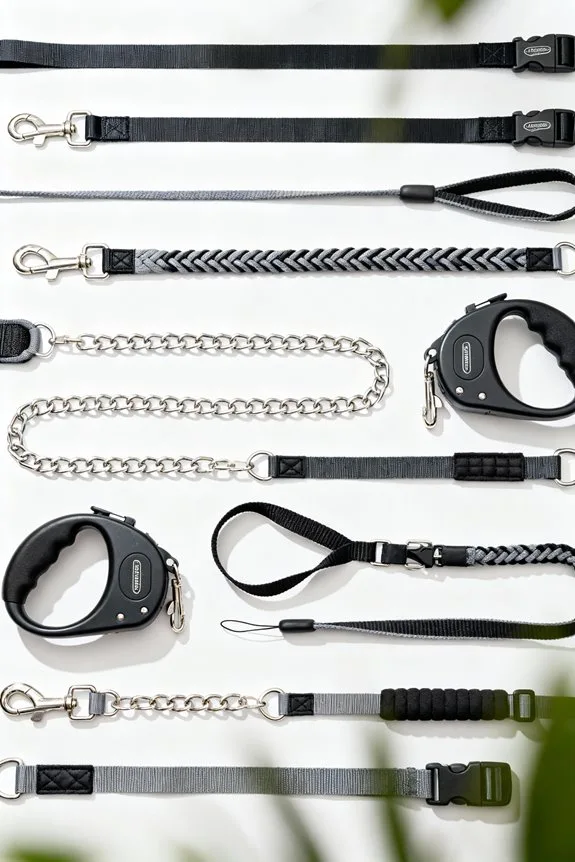
Durability should guide leash selection, as materials like biothane and nylon differ in life span, maintenance, and performance. Biothane is recommended for durability and ease of cleaning, while nylon remains the most common and economical leash material for everyday walking. Choose leash width based on dog size, for example 5/8-inch for small to medium dogs, and 3/4-inch for larger or untrained breeds needing more strength. Practice leash handling using two hands, one on the handle and one to gather slack, which improves control during training and reduces sudden jerks. Consider a waist belt for hands-free movement, allowing focused interaction and better body positioning during exercises. Inspect leash condition and snap quality regularly, to prevent rust, failure, or accidents, as dog trainers advise, frequently recommended. Many heavy-duty leashes feature reflective stitching to enhance visibility during nighttime walks, improving safety for both the dog and the owner.
Frequently Asked Questions
How Long Should My Training Leash Be?
Six-foot. Handlers should consider Training leash sizes, ideal leash length, leash length impact, beginner training leashes, leash length for puppies, adjustable leash benefits, shopping for leashes, custom leash options, training leash examples, safety leash lengths.
How to Choose Leash Length?
Like a conductor’s baton, they choose leash length by weighing leash types, dog behavior, puppy training goals, leash attachment and material, safety considerations, training techniques, leash control, handling distractions, and environmental factors for effective results.
What Is the 3 Second Rule for Dogs?
The 3-second rule prompts redirecting a dog’s attention within 3 seconds. It applies in dog behavior, training techniques, leash safety, obedience commands, positive reinforcement, distraction management, socialization tips, communication skills, problem solving, and exercise routines.
What Is the 123 Method for Dogs?
Clean, clear cues. The 123 Method: ‘1’ grabs attention, ‘2’ requests behavior, ‘3’ rewards. dog behavior, obedience commands, canine communication, distraction training, leash manners, positive reinforcement, training techniques, training equipment, leash types, and socialization tips.
Conclusion
A professional selects leash length by training objective, using a six-foot leash for control, a short two to four foot lead for strict management scenarios. Research indicates roughly seventy percent of owners see faster recall improvements when they incorporate long lines during progressive distance training sessions over several weeks typically. Which leash suits the moment depends on control needs, environment, and dog maturity, so trainers recommend matching length deliberately, then adjusting for safety and consistency.