As an Amazon Associate, we earn from qualifying purchases. Some links on this site are affiliate links at no extra cost to you. Our recommendations are based on thorough research and editorial judgment.


The Psychology of Reward-Based Training

Reward-based training applies operant conditioning, reinforcing desired actions with immediate rewards, typically within 1–2 seconds. Why does timing matter, does a prompt click or treat strengthen the action-outcome link rapidly? Dopamine release after rewards reinforces neural pathways, increasing motivation and the likelihood of repeated behavior. Research reports 50–70% reductions in stress, short 5–10 minute sessions, thrice daily, improve retention consistently. For cats, use 2–5 minute treats; avoid aversives, choose trainers offering written plans, help follows.
Key Takeaways
- Reward-based training uses operant conditioning: immediate positive reinforcement increases the likelihood of desired behaviors.
- Dopamine release links rewards to actions; immediate rewards (within ~2 seconds) strengthen learning.
- Shaping rewards successive approximations to build complex behaviors gradually and reliably.
- Reward-based methods reduce stress, aggression, and welfare harms compared with aversive techniques.
- Short, frequent sessions (2–10 minutes), consistent cues, and tracking frequency, latency, and duration optimize results.
What Reward-Based Training Means
You may be interested



Although grounded in basic behavioral science, reward-based training is straightforward to apply, and it centers on providing timely rewards after desired actions. It uses reward-based training methods that employ positive reinforcement, such as treats, praise, or toys, delivered within one second to mark correct behavior. Trainers ask, how does this improve behavior modification, and what outcomes are expected? Research reports dogs trained with rewards show 50–70% reductions in stress signs, and they exhibit less aggression and anxiety compared to aversive-trained cohorts. Animal welfare groups endorse these approaches, noting stronger trust, safer handling, and better long-term learning. In practice, humane dog training rewards desired responses while withholding rewards for undesired ones, creating clear contingencies, predictable feedback, and consistent progress. Trainers track sessions, repeats, and outcomes. Advanced obedience techniques can further enhance the effectiveness of reward-based training by promoting impulse control, precision recalls, and off-leash reliability.
Operant Conditioning: The Science Behind It
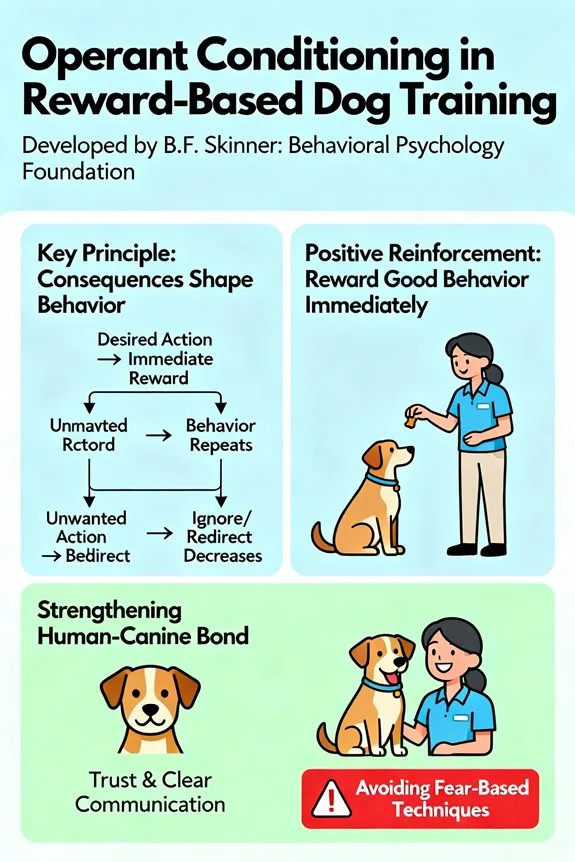
Because operant conditioning links actions with consequences, trainers can shape behavior predictably, using rewards or punishments to guide learning. B.F. Skinner formalized this approach, showing how consequences change action frequency, through experiments with measurable outcomes. Positive reinforcement rewards for behaviours, such as food or praise, increase repetition, dopamine strengthens neural pathways, making habits durable. How do reinforcement schedules affect learning, continuous schedules build fast acquisition, partial schedules slow extinction and maintain performance longer? Trainers apply operant conditioning across contexts, addressing behaviour issues like fear, distraction, or overactivity with structured consequences and monitoring. Studies show higher retention after reinforcement, versus aversive methods, producing more reliable, more humane outcomes. Practitioners measure frequency, latency, and duration, adjusting reinforcers and schedules to optimize animal behaviour, improving welfare outcomes. Incorporating tools like durable chew toys, which promote mental stimulation, can enhance training efficacy by providing an outlet for natural behaviors and reducing stress.
Positive Reinforcement Explained

Building on operant conditioning’s focus on consequences, positive reinforcement supplies rewards after desired actions, increasing behavior frequency through pleasant outcomes. Trainers provide treats, praise, or toys immediately after a desired behavior, typically within one second, to form a clear link and accelerate learning. How can trainers shape complex responses? They reward successive approximations, for example reinforcing three steps, then two, then the full action until the behavior is reliable. Consistency matters, so using the same cue and reward schedule, 80% consistency across sessions, prevents confusion and promotes retention. Varying rewards, such as high-value treats for new skills and toys for maintenance, sustains motivation during training methods across contexts. Measurements of progress use repetition counts, tracking ten successful responses per session as a concrete benchmark. Chew toys, like Benebone Wishbone, can be used as engaging rewards for puppies, offering both dental benefits and a fun playtime experience.
The Role of Dopamine in Learning
Consider dopamine as a chemical messenger that signals pleasure and prediction, released when a dog receives a reward and when rewards are anticipated. In reward-based dog training methods, dopamine is released after a desired action, reinforcing neural connections and increasing the probability of repeated behavior. How does this translate into practical training methods, and which examples make the process clear? For instance, four short training trials with tasty treats can produce measurable learning in minutes, while consistent sessions across days strengthen long-term retention. Studies indicate positive reinforcement raises dopamine, facilitating quicker task acquisition and improved performance. Consequently, trainers who time rewards and vary reinforcers see more resilient responses, because dopamine links action to outcome. Trainers apply these facts to motivate dogs, refine humane protocols. Additionally, using reflective materials on leashes can enhance safety during evening walks, making them more suitable for consistent training sessions in various lighting conditions.
Timing: Why Immediate Rewards Matter
When a trainer delivers a reward within two seconds after a dog’s correct response, the animal links action and outcome reliably. Trainers should use precise timing, immediate rewards, to mark the exact behavior, and to create a clear positive outcome for the learner. What happens when reinforcement is delayed by several seconds, minutes, or longer, and the link between action and consequence weakens? Studies show rewards given within one to two seconds increase repetition likelihood, accelerating learning and strengthening neural pathways tied to reward. For example, a treat delivered immediately after a sit, versus after a recall, produces clearer contingency and faster mastery. Thus, timely reinforcement reduces confusion, and promotes predictable responses across varied training scenarios, and builds confidence during household and public sessions. Consider using durable metal clickers to ensure reliable behavior marking due to their loud, clear sound, which enhances training effectiveness.
Consistency and Clear Cues
Consistently using the same verbal cue and hand signal, trainers reduce confusion, and dogs learn associations faster across varied environments. Consistency requires repeating identical commands and rewards every time, which prevents mixed signals and accelerates reliable learning. What happens when commands change unpredictably, or rewards arrive inconsistently, and how quickly does frustration follow? Positive reinforcement applied frequently, for example offering treats after five correct responses, produces faster acquisition and stronger retention. Clear cues paired with immediate rewards help generalize behaviors from home to park, and owners who follow routines report stronger bonds. Trainers should plan short sessions of three to five minutes, several times daily, to maintain focus and avoid boredom. Consistent expectations, measured rewards, and transparent signals together produce predictable, efficient outcomes reliably. Having adjustable waist belts on treat bags ensures comfort and accessibility during training, enhancing the efficiency of reward-based training sessions.
Shaping Complex Behaviors Step by Step
Although shaping requires patience, it breaks complex behaviors into small, reinforced steps, making learning predictable and measurable for both dog and trainer. Trainers reward successive approximations, for example reinforcing five incremental actions toward a trick, each within five to ten repetitions. What happens when a task exceeds current ability? They subdivide the task, teach a 3-step sequence, and reinforce each element with positive reinforcement. This training process reduces frustration, increases clarity, and speeds reliable acquisition of complex behaviors. In one scenario, a dog is guided through a twelve-move routine, taught as four triads of behaviors, with consistent rewards after each triad. Shaping also addresses anxiety, by reinforcing approach behaviors at gradually increasing distances, and fostering trust through predictable rewards. Progress is tracked with criteria. Clicker training offers clear communication and immediate feedback, which can significantly improve training outcomes.
Everyday Reward-Based Techniques for Dogs
Shaping complex behaviors into small, reinforced steps sets the stage for everyday reward-based techniques that fit daily routines and interactions. Trainers recommend short, consistent sessions of 5 to 10 minutes, three times daily, for reliable responses. Which immediate rewards work best, treats, praise, or play, depends on the individual dog’s preferences? Clicker training, a common reward-based methods example, uses a brief sound to mark a correct action, then delivers a treat. Positive reinforcement targets desirable behaviors, such as sitting calmly when doors open, waiting for food, or loose-leash walking. Clear commands, consistent timing, and rewarding the first correct response within one second improve learning, reducing confusion. Owners applying these training techniques see gains within two weeks, when practice is deliberate and rewards remain contingent. Dog training collars offer customizable training modes like beep, vibration, and static shock, which can complement reward-based methods by providing additional training cues.
Reward-Based Strategies for Cats
When introducing reward-based training to a cat, owners should use small edible treats, brief play, or soft praise immediately after desired behaviors. Reward-based methods rely on immediate rewards, such as one or two tiny treats given within one second of action. Training sessions should last two to five minutes, repeated three to five times daily, to build reliable responses. Positive reinforcement teaches specific behaviors, for example entering a carrier for treats, sitting on cue for play, or using a litter area. Consistency matters, use the same reward for the same behavior, and phase treats into intermittent schedules over two to four weeks. What improves learning, is predictable timing and clear cues, which reduce stress and support feline welfare. Early rewards often prevent behavior problems. For dog owners, using a leather braided leash can enhance control and comfort during training, similar to how consistency and reinforcement benefit cats.
Harms Associated With Aversive Methods
After outlining reward-based approaches, attention must shift to the harms of aversive methods, which produce measurable welfare declines in dogs. Aversive training methods, such as shock collars and physical punishment, increase fear, anxiety, and chronic stress, reducing overall welfare, and reduced resilience. Research shows dogs exposed to aversive methods display more aggression and stress-related illnesses, compared with those taught with positive reinforcement, and quicker retention. Dr. Rachel Casey reported greater pessimism in aversively trained dogs, indicating long-term emotional harm and altered cognitive bias, impairing decision making. Users of aversive methods often report lower satisfaction with obedience outcomes, suggesting inefficacy and weakened human-animal bonds. By contrast, positive reinforcement yields faster learning and improved performance, whereas aversive techniques create unintended risks, diminished welfare, and problematic behaviors. A detailed understanding of operant conditioning provides valuable insights into how positive reinforcement can effectively modify animal behavior while avoiding the negative impacts associated with aversive methods.
Choosing a Humane and Effective Trainer
How can an owner identify a humane, effective trainer, and what clear criteria distinguish positive practitioners from aversive ones? Owners should prioritize trainers who use reward-based methods, which studies link to stronger bonds and less stress. Trainers must demonstrate positive reinforcement tools, like timed food rewards and play, and show measurements of progress over weeks, not punishment. Aversive methods, such as shock or physical corrections, should be explicitly avoided due to increased fear and aggression risks. Effective trainers explain animal behavior basics, provide written plans, and record consistent, immediate reinforcement to improve learning. Seek formal education or certifications in behavior science, observe group classes for at least two sessions, and ask for client references with measurable outcomes. Assess training effectiveness using data, videos, references.
Further Reading and Practical Resources
Because reliable information guides practice, owners should assemble a concise library of vetted resources, including books, studies, and websites. Recommended readings stress reward-based methods, provide case studies, and compare outcomes for dogs and cats, using measurable behavior changes over time. How do studies quantify success, by percent compliance, latency reduction, or frequency increases, illustrating positive reinforcement benefits clearly and practical metrics? Websites like Companion Animal Psychology, plus social media groups, offer tools, step-by-step training techniques, and community troubleshooting support for pet owners. Practical resources list treat recommendations, with portions, caloric guidance, and timing examples, so sessions remain effective and welfare-centered throughout training plans. Education in animal behavior, whether short courses or multi-week workshops, reduces aversive practices, improves bonds, and prevents relapse into punishment situations.
Frequently Asked Questions
How Much Does Professional Reward-Based Training Typically Cost?
Typically $30–$150 per session or $200–$1,200 for packages, depending on cost comparison across trainers; choice reflects training package options, session frequency, trainer experience, and location factors influencing overall pricing and potential follow-up support fees estimated.
Do Trainers Need Certifications or Licenses for Reward-Based Methods?
Yes, like a compass guiding a ship, trainers often pursue certification requirements; they gain licensing benefits that support training effectiveness, uphold ethical considerations, and align practices with professional standards, ensuring greater credibility and client trust.
Can Children Safely Conduct Reward-Based Training With Pets?
Yes, children can safely conduct reward-based training with pets if child safety is prioritized, pet understanding is assessed, positive reinforcement is used, supervision importance is maintained, and training consistency is guaranteed for reliable, stress-free learning.
Will Pet Insurance Cover Behavior Training or Therapy Sessions?
Generally, no: most pet insurance policies exclude behavior therapy coverage, though some offer limited training expense reimbursement when prescribed by a veterinarian, still acknowledging veterinary support role and potential mental health benefits for animal–owner wellbeing.
Do Airlines or Hotels Recognize Animals Trained Solely With Rewards?
Sometimes. Airline policies and hotel recognition standards prioritize documentation, task-specific skills, and animal behavior evidence; certification for pet travel or emotional support affects recognition, but acceptance varies widely among carriers and properties by jurisdictional rules.
Conclusion
The conclusion outlines core reward-based training concepts, including timing, dopamine, reinforcement, and humane principles. How does immediacy, for example treats delivered within one to three seconds, accelerate learning retention? If rewards are predictable, desired behaviors increase reliably; if unpredictable, errors rise and learning stalls. Use three small treats for simple cues, and twenty repetitions for complex behaviors per session. Training is like building a bridge, requiring repeated, timely supports, evidence-based choices, and ethical consistency.