As an Amazon Associate, we earn from qualifying purchases. Some links on this site are affiliate links at no extra cost to you. Our recommendations are based on thorough research and editorial judgment.

Understanding Classical Vs Operant Conditioning in Pet Training

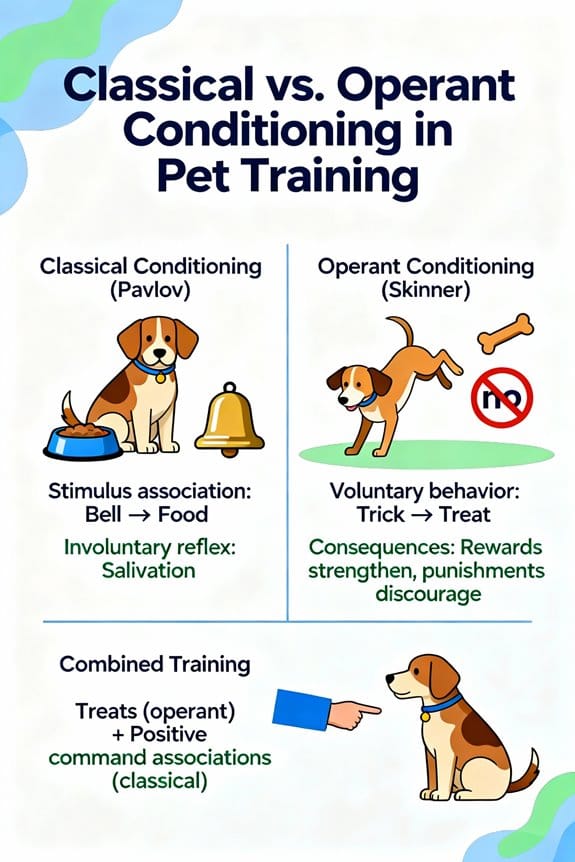
Operant conditioning changes voluntary actions via consequences, for example giving a treat after a sit, or removing leash pressure when pulling stops. Classical conditioning pairs neutral cues with reflexes, for example a bell or leash becomes positive after ten to fifteen exposures. Consider which method addresses a fear versus an unwanted behavior, since classical reshapes emotions and operant changes choices. Use classical to build calm associations, then operant to reinforce specific skills, more examples follow.
Key Takeaways
- Classical conditioning pairs neutral stimuli with involuntary responses; operant conditioning links voluntary behaviors with consequences.
- Use classical conditioning for emotional associations and socialization, operant conditioning to teach commands and shape voluntary behaviors.
- Classical requires consistent timing and pairing; operant uses four quadrants—positive/negative reinforcement and punishment—to modify behavior.
- Clicker training is operant: an immediate marker signals the exact behavior to reinforce with a reward.
- Combine methods: classical creates positive emotional context, operant reinforces desired actions for reliable, force-free training.
What Is Operant Conditioning?
You may be interested



When a dog performs an intentional action, operant conditioning links that operant response with a consequence, shaping future behavior through predictable results. It was defined by B.F. Skinner, and it strengthens voluntary behaviors by applying consequences such as rewards or punishments. What are the categories used to modify behavior, and how are they applied in practice? Trainers use four quadrants, positive reinforcement, negative reinforcement, positive punishment, and negative punishment, to increase or decrease actions. For example, giving a treat three times after a sit, or removing a leash pressure when the dog stops pulling, demonstrates cause-and-effect learning. This method teaches commands, manners, and complex tricks, with measurable progress over sessions, and promotes balanced, consistent training when rewards are applied thoughtfully for reliable long-term results. Clicker training is a powerful tool that enhances the effectiveness of operant conditioning by providing immediate auditory feedback to reinforce desired behaviors.
Recommended Products

Extended Range Training System: E-Collar EZ-904 1/2-mile range trainer for small to medium sized dogs 10 pounds and up with neck size 5 to 22-1/2 inches is loaded with unique features, making it the most humane and effective trainer available

NEW BOOST & LOCK FEATURES: Enhance your training experience with the superior Boost button. The constant correction with a customizable Boost button allows for instant level increases to immediately recall you dog. Go from training mode to obedience mode easily by setting your own custom Boost to jump to your enhanced training level seamlessly. The newly introduced Safety Level Lock prevents unwanted or accidental level changes for an active training style.

Two Dog System with Extended Range: The Upland UL-1202 two dog system with 1 mile range, large receiver for large dogs 20 pounds and larger with neck size 6 to 22 inches
What Is Classical Conditioning?
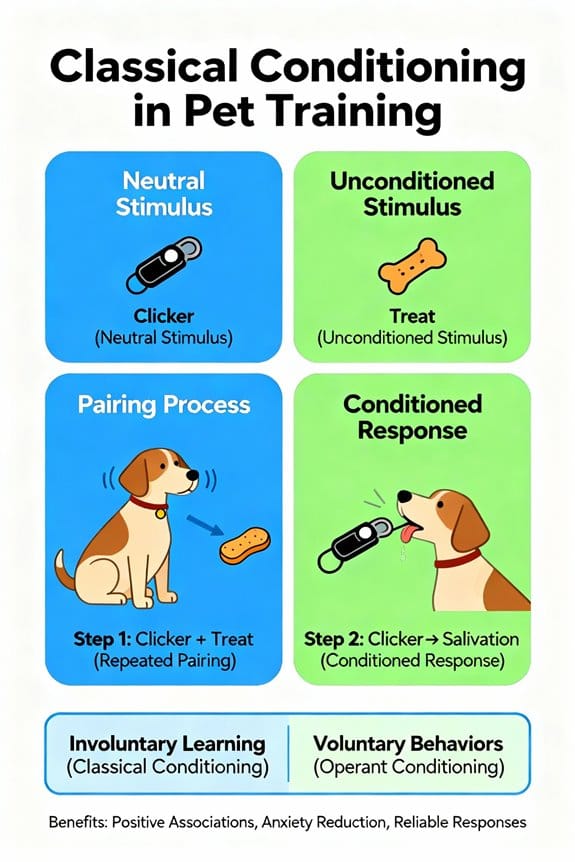
Although it occurs without conscious effort, classical conditioning pairs an involuntary response with a neutral cue, producing predictable behavior change. In this framework, an unconditioned response like salivation to food becomes linked to a neutral stimulus such as a bell in dogs. How does a bell alone later trigger salivation, after repeated pairings with food, in controlled trials in laboratories? The bell, once paired consistently, becomes capable of eliciting a conditioned response, demonstrating learned association through repetition and timing. Trainers use this passive learning method during early socialization, pairing leashes or car rides with positive experiences to change emotional reactions. Classical conditioning alters reflexive behaviors and emotional responses, and it requires careful, repeated pairings for reliable results in practical pet training, with consistent timing. Dog pee pads with built-in attractants can also utilize principles of conditioning to guide dogs toward their use, enhancing training success.
Key Differences Between Classical and Operant Conditioning
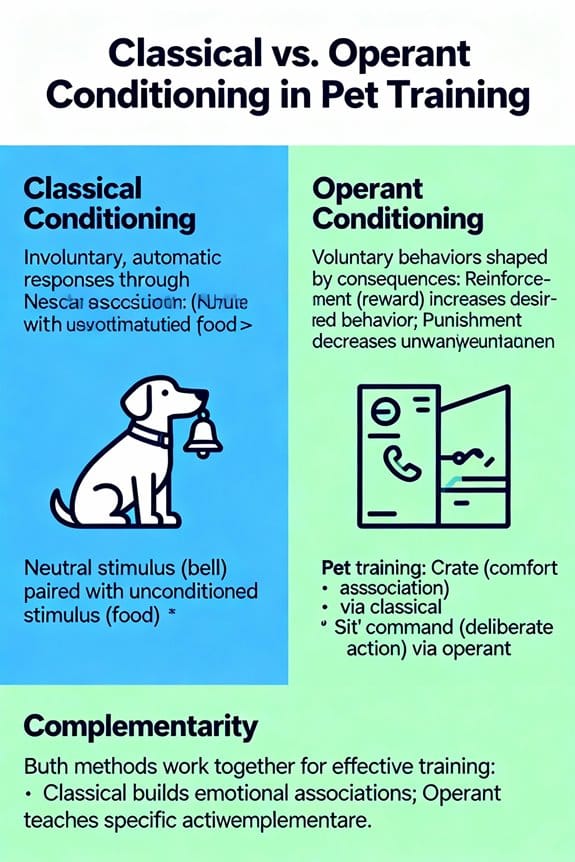
Because trainers need different tools for different problems, it is important to distinguish classical conditioning from operant conditioning in practice. Operant conditioning changes voluntary actions through consequences, for example a dog receives a treat 80% of the time after sitting, reinforcing that behavior. Classical conditioning creates automatic responses by pairing stimuli, for example a bell played with feeding until the bell alone elicits salivation. Which situation requires which method, problem behavior reduction or emotional association? Operant methods use four quadrants—positive reinforcement, negative reinforcement, positive punishment, negative punishment—allowing precise behavior shaping with measurable rates. Classical conditioning, by contrast, relies on stimulus pairing to build conditioned responses without active choices by the animal. Effective dog training applies each approach where it best addresses specific needs effectively. Force-free training methods focus on positive reinforcement to encourage desired behaviors while minimizing stress and anxiety for the dog.
Recommended Products

The ECO version refresh of our popular dog training vest features a softer shell fabric for more comfort and roomier, quick-access pockets that make rewarding your dog even easier

Exceptional comfort: Made with a lightweight and comfortable design, our dog training windbreaker ensures you stay cozy during training sessions.

2 WAYS TO WEAR: The adjustable carrying strap can be fashioned into a fanny pack or a cross body bag giving you options while providing easy access to treats during puppy training
How Conditioned Emotional Responses Affect Pets
Having distinguished operant from classical methods, attention now shifts to how conditioned emotional responses shape a pet’s reactions and learning. Classical conditioning explains how a neutral cue becomes linked to reward, producing anticipatory behavior and positive affect. For example, dogs may show joy at a leash, or vocalize at a car, after ten paired experiences. How do these emotional responses alter training outcomes, and does cooperation become more reliable under positive associations? Negative experiences create avoidance, make learning slower, and require systematic desensitization to restore trust and engagement. Trainers can intentionally build positive CERs using consistent rewards, varied reinforcers, and timing, thereby enhancing session effectiveness. Recognizing cues, documenting three to five reliable pairings, and reinforcing desired reactions helps owners shape cooperative behavior over weeks. Reward-based training techniques emphasize positive reinforcement by using treats, toys, or praise to mark behaviors, which strengthens the emotional bond between pets and owners.
Recommended Products

Strong Natural Aroma Dogs Love - Naturally rich scent helps grab attention, making them ideal for training and rewarding

Remote Treat Tossing: With pet dog camera, reward & interact with your pet from anywhere! Dispense healthy treats remotely feeding of 7-12mm pet food and interactive light to keep your dog engaged and active when you're away. The dog camera with phone app.

PLEASE MEASURE YOUR DOG & CHECK OUR SIZE GUIDE: Max back length 14"-19'', chest girth 19"-30''. Ensure your dog fits within the sizing guidelines before purchasing.
Combining Classical and Operant Methods in Training
When combined thoughtfully, classical and operant conditioning form a complementary system, creating predictable associations and shaping voluntary actions. Trainers use classical conditioning to build positive emotional responses to cues, and operant conditioning to reinforce desired behaviors, producing more reliable dog behavior overall. For example, sight of a leash may be paired with treats across 10 short sessions, creating calm anticipation, while rewarding calm responses strengthens that association. How do associations and consequences interact in practice? Reflexive emotions set a foundation, and consequences shape voluntary choices, so trainers address both automatic responses and learned actions. In one scenario, a noise becomes neutral in 5 exposures, then cues are reinforced for calm responses; in another, play precedes training, increasing engagement and retention. This yields measurable improvements. An effective puppy training routine can aid in predictable potty times, as consistent scheduling and positive reinforcement are crucial for successful house training.
Recommended Products

2-in-1 bike trailer and stroller with included 1-Wheel Stroller Kit and adjustable handlebar

All-in-One Bundle - Our full service dog starter kit includes an adjustable XS service dog harness with chest pad, 8" clip-on bridge service dog handle, registered service dog ID card, service dog id holder, red medical alert tag, 5" service dog leash wrap, 2 x service dog patches with velcro and 25 x ADA Federal Service Dog Law cards

Complete Puppy Starter Kit: This 72-piece puppy starter kit is very comprehensive, eliminating the need for additional purchases. Our beautifully designed pink-themed puppy starter kit combines practicality and aesthetics. The kit includes a dog bed, blankets for both winter and summer, food storage containers, a toothbrush, various dog toys, a dog bowl, a leash, nail clippers, and everything else a puppy needs
Practical Tips for Applying Operant Conditioning
Begin each training session with a clear goal, a consistent cue, and a primary reward, repeating the exercise in short, frequent bursts. Trainers should apply operant conditioning by using immediate rewards, treats or praise, within one second after a correct response to strengthen the association. How often should sessions occur, two to five minutes each, four to six times daily provides reliable reinforcement? Implement positive reinforcement variably, alternating treats, playtime, and affection to sustain motivation and prevent satiation. Use negative punishment sparingly, removing a toy or ending play immediately when an unwanted behavior occurs, to reduce recurrence. Maintain consistent commands and signals, repeat actions until reliable, and adjust rewards based on progress and context to shape durable behaviors. Record sessions, monitor timing, and progress. When selecting a dog whistle for training, consider factors such as frequency and pitch to ensure it suits your dog’s hearing capabilities and training needs.
Recommended Products

Premium 304 Stainless Steel UK Made Construction: The Logan 304 Sheepdog Whistle is precision machined in the UK from a single piece of high-quality stainless steel and hand finished for maximum durability and performance. Built for professional use, it delivers long-lasting reliability in all training environments.

Superior quality solid stainless steel dog training whistle with excellent range of tones and sound projection

Premium Solid Brass UK Made Construction; The Logan Turbo Brass Whistle is precision crafted in the UK from solid musical instrument grade brass with no rivets or joins. Designed as a pure form for pure sound, it delivers exceptional durability and professional-level acoustic performance.
Frequently Asked Questions
What Is the Difference Between Classical and Operant Conditioning in Dog Training?
Classical conditioning pairs stimuli to elicit involuntary responses, while operant conditioning shapes voluntary behavior through consequences; trainers combine positive reinforcement techniques, consider training motivation factors, and apply behavioral consistency methods to achieve reliable dog responses.
How Is Classical Conditioning Used in Dog Training?
Classical conditioning pairs neutral stimuli with meaningful events to build cue association and shape emotional responses. Trainers may use clicker training techniques to mark timing, reinforcing positive anticipation and relaxed responses without rewarding specific actions.
How Is Operant Conditioning Used in Dog Training?
Operant conditioning guides dogs like a compass, employing positive reinforcement techniques, clicker training methods, and consequences; the trainer applies consistent behavior modification strategies to strengthen desired actions and suppress unwanted ones through timing and repetition.
What Is the Difference Between Classical Conditioning and Operant Conditioning?
Classical conditioning links involuntary reflexes to stimuli, while operant conditioning shapes voluntary actions through consequences; behavioral psychology distinguishes passive association from active reinforcement, noting reinforcement schedules and effects on instinctual behaviors in animal training contexts.
Conclusion
The conclusion explains how classical cues create reflexes, while operant methods shape voluntary behaviors through reinforcement schedules. Which approach suits a fearful dog, for example, classical desensitization paired with gradual exposure, or reward-based shaping? Trainers should use clear antecedents, consistent rewards, timed consequences, and short sessions, so learning consolidates faster and unwanted behaviors decrease, and repetition. Significantly, studies show about 70% of pets respond better to positive reinforcement, a statistic that guides practical training choices.