As an Amazon Associate, we earn from qualifying purchases. Some links on this site are affiliate links at no extra cost to you. Our recommendations are based on thorough research and editorial judgment.


The Science Behind Positive Reinforcement Training

Positive reinforcement training rewards desired behaviors with treats, praise, or toys, producing rapid dopamine-driven learning. Immediate rewards within one to two seconds strengthen associations, increasing recall success to about 90%? Continuous rewards build habits quickly, and intermittent rewards, used later, maintain them and improve retention. This method lowers stress biomarkers, fosters trust, and avoids fear and aggression linked to punishment. Guidance explains timing, shaping steps, limits for severe problems, and how to proceed to success.
Key Takeaways
- Positive reinforcement uses operant conditioning: rewarding desired behaviors increases their future frequency through predictable positive outcomes.
- Immediate rewards (within 1–2 seconds) trigger dopamine release, strengthening the behavior–reward association and improving learning speed.
- Starting with continuous rewards then shifting to intermittent reinforcement increases retention and long-term reliability of trained behaviors.
- Reward-based training lowers stress markers, enhances emotional well-being, and builds trust and clearer communication between dog and handler.
- Limitations include reduced effectiveness for severe fear/aggression and potential treat-dependency without management, corrections, or alternate behavior training.
What Is Positive Reinforcement Training?
You may be interested



Positive reinforcement training is a method that rewards desired behaviors, such as sitting or staying, using treats, praise, or toys. It relies on operant conditioning principles, where actions followed by positive outcomes increase in frequency, and trainers apply immediate rewards within one to two seconds. How quickly should a reward be given to link the action and outcome? Studies report recall success near ninety percent with reward-based approaches, compared with thirty to fifty percent after punishment. Trainers select clear cues, reward consistency, and scale rewards from treats to praise or play, so behaviors generalize across settings. This approach reduces stress, builds a trusting relationship between dog and owner, and promotes lasting behavior changes, while enabling higher engagement and enthusiasm to learn during sessions effectively. Many dog trainers prefer using training treat bags with quick-access features to efficiently dispense rewards during sessions.
The Science Behind Reward-Based Learning
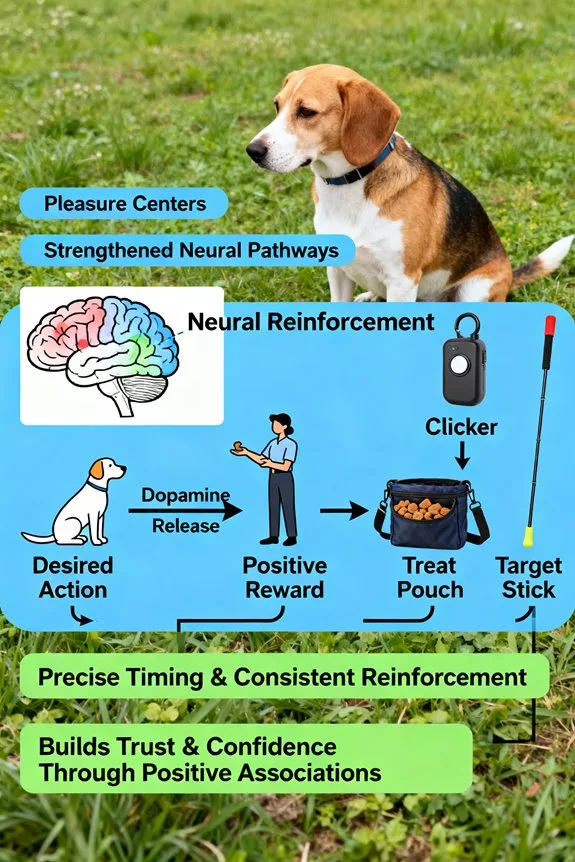
Operant conditioning, formulated by B.F. Skinner, explains how consequences change behavior, and underpins modern reward-based training. Positive reinforcement techniques reward desired responses, increasing their frequency through consistent application, and this approach informs clear behavior modification plans for dogs. Which training methods produce reliable results, reward-based systems show evidence, with recall success near 90% compared with thirty to fifty percent using punishment-based approaches. Trainers observe lower stress, greater engagement, and faster learning when reinforcement replaces correction, and owners report stronger bonds and less fear. Practical scenarios include short, frequent sessions with high-value rewards, gradual difficulty increases, and reinforcement for approximations of target behaviors. Collar training can commence around 8-10 weeks, with veterinary coordination recommended for apt usage. The science behind positive reinforcement emphasizes measurable outcomes, ethical application, and repeatable protocols for improving dog behavior across diverse breeds and contexts.
Neurochemistry: How Rewards Shape Behavior

Dopamine release in a dog’s brain acts as a chemical signal, strengthening connections between a rewarded action and its outcome. Neurochemistry shows that when rewards follow behavior repeatedly, synaptic pathways strengthen, increasing repeat probability by observable margins, for example two- to threefold in lab studies. How does this guide training decisions, and when should rewards be timed? Positive reinforcement requires immediate, consistent rewards within one to three seconds, otherwise association weakens and learning slows. Operant conditioning principles predict higher retention when schedules shift from continuous to intermittent rewards, for instance rewarding every third response, then variable ratios. Studies also report lower stress markers in reward-trained dogs, suggesting healthier neurochemical profiles, and trainers can use these findings to design effective, measurable training plans and goals. Using puppy training bells can enhance communication between the dog and the owner, providing a structured method for signaling needs and reinforcing positive behavior.
Benefits for Canine Welfare and Engagement
Neurochemical research showing rapid dopamine release after rewards helps explain why reward-based training improves welfare and engagement in dogs. Positive reinforcement lowers stress hormones, promotes emotional well-being, and reduces anxiety-related behaviors, leading to calmer daily routines and fewer problem behaviors. Studies report recall success rates near 90% for dogs trained using reward-based methods, compared with 30–50% for other approaches, so engagement and enthusiasm to learn increase measurably. Positive reinforcement techniques are emphasized by modern trainers as part of a science-backed methodology that fosters trust and faster learning. How does this strengthen relationships between dog owners and their animals, and why does it matter for long-term welfare? Because consistent rewards reinforce good behavior, owners can shape durable habits, reduce relapse, and encourage proactive management. This process, building trust through predictable outcomes, enhances communication, and supports a joyful, collaborative learning environment, and also improves overall welfare.
Punishment-Based Methods: Risks and Limitations
Although intended to curb unwanted actions, punishment-based methods often increase fear and anxiety, producing immediate suppression but longer-term problems. Researchers report aggression rates up to 14% in dogs trained with punishment-based methods, illustrating increased risk compared with positive reinforcement approaches. Why do undesirable behaviors persist despite punitive attempts, and how does confusion result when no alternative behaviors are taught? Punishment may suppress actions briefly, but it does not teach acceptable alternatives, so recall success falls to only 30–50% in some studies. Positive reinforcement, by contrast, yields recall rates near 90%, and promotes engagement and learning. Overreliance on punitive measures can foster learned helplessness, causing long-term emotional harm and reduced behavioral flexibility. Handlers should prioritize rewards, clear cues, and consistent reinforcement to improve outcomes rapidly. In multi-dog households, effective training techniques create harmony by establishing routines and encouraging teamwork among pets.
Common Myths About Positive Reinforcement
How can positive reinforcement be dismissed as mere bribery, when it instead systematically rewards effort and can be faded over time? Research shows positive reinforcement teaches alternative responses, it helps correct unwanted behaviors by reinforcing acceptable choices in 70% of studied cases. Trainers note two scenarios: one, shaping a sit with small treats over 10 repetitions; two, replacing jumping with calm greetings, both reduce problem behaviors. Positive reinforcement is rarely standalone, it pairs with management and targeted corrections to address underlying anxiety and promote lasting trust. Cause-and-effect is evident: fear-based methods increase aggression and anxiety, whereas reward-based plans increase learning, engagement, and behavior modification. Practitioners adjust reinforcers per dog, use consistent cues across 2–3 contexts, and measure progress with objective criteria, like frequency reductions. Clicker training kits, such as the Dog Clicker Training Kit with Silicone Treat Pouch and Magnetic Waist-Clip Treat Bag, have been shown to enhance the efficiency of positive reinforcement training by providing clear sound cues and easy access to treats, reinforcing desired behaviors effectively.
Choosing Effective Rewards and Training Tools
Rewards selection is foundational, because different dogs prefer different incentives—food, toys, play, or praise, and matching preference increases reinforcement efficacy. Trainers should identify effective rewards through preference tests, offering small food samples, toy choices, or short play bursts, observing immediate engagement and choice patterns. What training tools support delivery, precision, and convenience during sessions? Clickers provide precise cues, treat pouches allow rapid access to food, and varied toys supply alternates that sustain interest. Positive reinforcement succeeds when rewards are timely, varied, and consistent, so trainers should plan sessions with clear objectives, fixed signals, and rotation of diverse rewards to avoid satiation. Adjustments follow the dog’s response, maintaining motivation while reducing dependence on a single reward type. Record outcomes numerically, noting success rates and latency. When training dogs to use doggie doorbells, it’s important to incorporate short, consistent sessions with rewards to establish effective learning.
Timing, Consistency, and the Art of Shaping Behavior
Precision in delivery, timing, and consistent signals determine whether a behavior links to a cue, so handlers must act within 1–2 seconds. Consistent cues and rewards, given in that 1–2 second window, reduce confusion, and speed learning across diverse training scenarios. Clear timing, and strict consistency, guarantee the dog connects a specific action to a cue, reinforcing correct responses reliably. When using positive reinforcement, trainers reward calm approximations, for example one-second sits, then two-second holds, increasing duration gradually. Shaping behavior, applied step-by-step, rewards successive approximations, so a complex task is built from simple, reinforced components, encouraging confidence and loyalty. A distinct and loud click captures the pet’s attention effectively, enhancing the communication during training sessions. How does consistent communication affect outcomes, and why does immediate feedback increase engagement and long-term trust, producing faster recall, steadier responses, within about ten sessions?
Redirecting and Managing Misbehavior Without Punishment
Teach an alternative behavior immediately when misbehavior appears, for example asking for a sit instead of scolding a jumping dog. Redirecting misbehavior uses clear cues, immediate rewards, and repetition to teach one alternative per problem, for instance sit for jumping, down for lunging, and leave for mouthing. How quickly should reinforcement follow a response, within one second, so the dog links action to reward? Positive reinforcement requires consistency, small food rewards or praise given five to ten times per session, and gradual fading as reliability improves. This approach builds trust, reduces anxiety, and clarifies acceptable behaviors through predictable expectations. Owners should plan short, frequent sessions, measure progress with simple counts, and avoid punishment that creates confusion or fear. Consistent, daily practice of short sessions produces dependable, calm outcomes over weeks. Advanced obedience techniques promote impulse control, precision recalls, trained stays, and off-leash reliability, which can complement positive reinforcement training by providing structured progression and focus.
When Reward-Based Training Alone May Fall Short
Although positive reinforcement forms the foundation of humane training, it can be insufficient for dogs with deeper behavioral problems, such as severe fear or aggression. Trainers note that positive reinforcement may not resolve complex behavioral issues, for example dogs with chronic anxiety that freeze or lunge. Another scenario is learned aggression toward strangers, which often requires early correction before reward methods take effect. Can rewards alone address a dog that often reacts to noise, or to prior trauma? Over-reliance on treats can create dependency, causing a dog to perform only when given rewards, and hindering generalization to new contexts. In some cases, measured correction or management is needed first, then gradual reward-based shaping can proceed. Without balance, progress stalls, and owners often need help. For active or water-loving dogs, Biothane collars are recommended due to their durability, allowing for training sessions in various environments without worry of wear and tear.
Finding the Right Trainer and Setting for Success
How might a pet owner identify a trainer who combines certification, behavioral knowledge, and practical experience for successful outcomes? Seek practitioners who teach positive reinforcement, hold credentials, and demonstrate dog behavior knowledge, with documented cases and regular results over time. Ask whether dog trainers offer private lessons and group classes, how many dogs per class, and specific positive training feedback methods. Observe a trial training session, note the environment, the coach’s tone, reward timing, and how calm dogs respond during training sessions. Check testimonials, seek three to five references, prefer consistent locations and methods, and expect measurable progress within six to eight weeks. Hire a certified dog professional when possible, because credentialed staff apply consistent positive training protocols, reducing confusion over time.
Frequently Asked Questions
How Much Does Professional Positive Reinforcement Training Typically Cost?
Typically, professional positive reinforcement training costs $50–$200 per session; training package prices, private session costs, group class fees, regional pricing differences, and budget friendly options influence the final amount pet owners pay overall by region.
Are There Health or Calorie Concerns With Frequent Treat-Based Training?
Yes—hidden risks emerge. They must monitor calorie management, consider treat alternatives, observe frequency limits, and weigh health implications; trainers maintain training balance to prevent weight gain, nutritional issues, or behavioral dependency through portions and alternatives.
Can Children Safely and Effectively Participate in Training Sessions?
Yes, children can safely and effectively participate in training sessions when child involvement is structured, safety measures enforced, appropriate training techniques used, age appropriateness considered, and parental supervision guarantees guidance, consistency, and immediate intervention support.
How Do You Maintain Training Progress When Traveling or Boarding Your Dog?
A gentle detour keeps momentum: they use travel tips and boarding strategies, maintain consistency techniques, enact environment adaptation, and employ progress tracking. Short routines, familiar cues, reward-portable treats, and daily photo logs preserve learned behaviors.
Is Positive Reinforcement Training Effective for Other Species Besides Dogs?
Yes, it is effective: animal behavior studies demonstrate positive reinforcement effectiveness across taxa, though training different species requires species specific adaptations, emphasizing rewards versus punishments to shape behaviors while minimizing stress and improving learning outcomes.
Conclusion
The conclusion frames positive reinforcement as a reliable compass, guiding trainers through measurable steps, reproducible rewards, and observable progress toward cooperative, stress-reduced canine behavior patterns. Should trainers track treats per session, reward timing to the nearest half-second, and incremental criteria, and documentation, will learning accelerate predictably under consistent reinforcement effectively? When timing, consistency, and context align, handlers reduce stress-related aggression, increase skill retention by 40-60 percent, and create adaptable, socially resilient dogs across varied environments.